Mastering Medical Visuals: A Guide to the Hospital Bed Flat Vector Object Set
In the rapidly evolving landscape of digital healthcare communication, the clarity of visual assets can make the difference between confusion and understanding. Whether you are a graphic designer building a hospital website, an animator creating training modules for nursing staff, or a business owner developing marketing materials for a new clinic, the quality of your imagery matters immensely. This is where the Hospital Bed Flat Vector Object Set becomes an indispensable resource. Unlike traditional photography or complex 3D renders, flat vector illustrations offer a unique blend of simplicity, scalability, and stylistic versatility that resonates with modern audiences.
This article explores the practical applications, inherent value, and strategic implementation of these vector collections, specifically focusing on how they serve various sectors of the medical and design industries. We will delve into why these assets are preferred for web graphics, animation, and print, and how they compare to other visual formats like the hospital bed flat color vector object set.
The Power of Flat Design in Healthcare Communication
Flat design has taken the digital world by storm, and for good reason. It strips away unnecessary textures, gradients, and shadows to focus on the core message. In a medical context, where information overload is common, this minimalist approach helps viewers process data faster. The Hospital Bed Flat Vector Object Set leverages this philosophy by providing clean, distinct shapes that represent essential medical furniture without visual clutter.
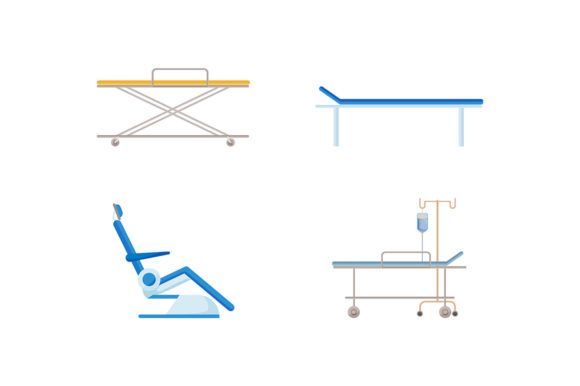
When users encounter a webpage or an app interface, their cognitive load is already high. They are often looking for specific information: "Where is the emergency room?" or "What does a standard patient room look like?" A detailed photograph might distract with background noise or lighting issues. In contrast, a vector illustration isolates the subject, drawing the eye immediately to the object itself. This is particularly true for items like the table for emergency patient transportation. In a vector format, the wheels, the mattress, and the side rails are defined by clear lines and solid colors, making the function of the equipment instantly recognizable even at small sizes on mobile screens.
Scalability and Technical Flexibility
One of the most significant advantages of using a vector object set is scalability. Vector graphics are mathematically defined paths rather than grids of pixels. This means you can resize a dentist office chair from a tiny icon in a navigation bar to a massive banner on a homepage without losing any quality. There is no pixelation, no blurring, and no loss of detail. For professionals working across multiple platforms—such as responsive websites, high-resolution print brochures, and large-format signage—this flexibility is crucial.
Furthermore, the file formats typically included in these sets, such as EPS and JPG, cater to different needs within a workflow. The EPS (Encapsulated PostScript) file is the gold standard for editors who need to manipulate individual elements. You can change the color of the sheets on a bed to match a specific brand palette or adjust the angle of a clinic chair to fit a layout. The JPG versions provide ready-to-use raster images for quick deployment in presentations or social media posts where editing isn't required. Having both formats in a single ZIP file ensures that creators are prepared for any scenario.
Diverse Applications Across Medical Specialties
The utility of a comprehensive Hospital Bed Flat Vector Object Set extends far beyond general hospital imagery. Different medical specialties require specific furniture and equipment, and a well-curated set addresses these nuances. Let's examine how these assets serve different environments:
- Emergency Services: Speed and clarity are paramount in emergency care visuals. Illustrations of a table for emergency patient transportation (often known as a gurney or stretcher) are vital for wayfinding signs, ambulance service websites, and triage instructional videos. The flat style ensures that the mechanism of the bed is clear, helping patients and families understand the transport process without fear.
- Dental Practices: Dentistry has a unique aesthetic, often aiming to reduce patient anxiety. A dentist office chair depicted in a friendly, cartoon-style vector illustration can soften the clinical feel of a website. These chairs have distinct features like headrests, spittoons, and articulated arms. A good vector set captures these details simply, allowing web designers to create welcoming landing pages that reassure nervous patients.
- General Clinics and Outpatient Centers: For broader clinic furniture, isolation is key. When an illustration is described as "isolated," it means the background is transparent or easily removable. This allows designers to place a clinic furniture isolated cartoon illustration onto any colored background or integrate it seamlessly into complex animations. Whether it's a waiting room bench or an examination table, these assets help build a cohesive visual identity for the facility.
Animation and Interactive Media
The rise of interactive web design and e-learning has created a surge in demand for assets suitable for animation. The Hospital Bed Flat Vector Object Set is perfectly suited for this medium. Because the objects are composed of distinct layers and shapes, animators can easily rig them for movement. Imagine an educational video explaining how to adjust a hospital bed for a patient with respiratory issues. Using vector assets, an animator can smoothly rotate the backrest or raise the legs of the bed without the image degrading.
Similarly, for web interactions, hover effects become much more engaging with vectors. A user might hover over a dentist office chair icon, causing it to gently bounce or change color, providing immediate visual feedback. This level of interactivity enhances user experience (UX) and keeps visitors engaged with the content longer. The "cartoon illustration" style mentioned in many asset descriptions adds a layer of approachability, making dry medical topics feel more accessible and less intimidating.
Evaluating Suitability for Your Projects
Before integrating a Hospital Bed Flat Vector Object Set into your workflow, it is essential to evaluate whether it aligns with your project goals. While these assets are incredibly versatile, they are not a one-size-fits-all solution for every context.
- Brand Alignment: Does the flat, cartoonish style match your brand voice? If you are a high-end surgical center aiming for a hyper-realistic, serious tone, a colorful cartoon vector might feel too playful. However, for pediatric wards, telehealth apps, or community health initiatives, this style is often perfect.
- Customization Needs: Check the file structure of the EPS files. Are the elements grouped logically? Can you easily recolor the table for emergency patient transportation to match your ambulance service's livery? The ability to edit is the primary advantage of vectors over static photos.
- Consistency: Ensure the set includes all the necessary components you need. A disjointed collection where the dentist office chair looks like it belongs to a different art style than the hospital bed can undermine the professionalism of your design. Look for sets that offer a cohesive "family" of objects.
Strengths and Limitations
It is important to maintain realistic expectations. The primary strength of the Hospital Bed Flat Vector Object Set lies in its clarity and adaptability. It excels in iconography, infographics, UI design, and explanatory animations. It loads quickly on websites, improving page speed scores—a critical factor for SEO and user retention.
However, there are limitations. If your project requires photorealism to show specific texture details, such as the weave of a fabric or the metallic sheen of a specific steel alloy, vectors may fall short. Flat design abstracts these details. Additionally, while "cartoon illustration" styles are engaging, they must be used carefully in contexts involving serious medical conditions to avoid appearing dismissive. The tone must always remain respectful and informative.
Real-World Scenarios and Implementation
Consider a startup developing a mobile app for booking doctor appointments. They need icons for different types of visits. Using a clinic furniture isolated cartoon illustration of a general exam table for "General Practice" and a dentist office chair for "Dental Care" creates an intuitive visual language. Users can scan the menu and instantly know which option to select, reducing friction in the booking process.
In another scenario, a medical supply company is updating its catalog. Instead of expensive photo shoots for every new model of bed, they license a comprehensive vector set. They use the Hospital Bed Flat Vector Object Set as a base, tweaking the colors and adding logos to represent their specific product line. This saves thousands of dollars in production costs and allows for rapid updates when new products launch.
Furthermore, educators creating online courses for nursing students can utilize these assets to build diagrams. By layering a table for emergency patient transportation over a floor plan, they can demonstrate optimal room layouts for trauma bays. The clean lines of the vector ensure that the diagram remains legible even when projected in a large lecture hall.
Conclusion
The Hospital Bed Flat Vector Object Set represents more than just a collection of images; it is a toolkit for clearer communication in the healthcare sector. From the dentist office chair to the table for emergency patient transportation, these assets bridge the gap between complex medical realities and user-friendly digital experiences. By offering scalability, ease of animation, and a friendly aesthetic, they empower designers, developers, and business owners to create content that is both professional and accessible.
As the digital world continues to prioritize speed, clarity, and mobile responsiveness, the shift towards flat vector graphics is likely to persist. For those seeking to enhance their web graphic design and animation projects, investing in a high-quality, versatile vector set is a strategic move. It ensures that your visual content not only looks good but also serves its primary purpose: to inform, guide, and reassure the people who need it most. Whether you are building a simple landing page or a complex interactive training module, these isolated, editable, and vibrant illustrations provide the foundation for success.