Elevating Digital Interfaces with Isometric 3D Media Icons
In the rapidly evolving landscape of digital design, the visual language used to communicate functionality is just as critical as the code that powers it. Among the most significant trends reshaping user interface (UI) and user experience (UX) design is the shift toward depth, dimension, and realism. At the forefront of this movement is the Media Icons Set, Isometric 3d Style, a collection of universal media elements designed to bridge the gap between flat minimalism and immersive interaction. These assets are not merely decorative; they serve as essential navigational beacons for web and mobile applications, offering clarity through sophisticated geometric construction.
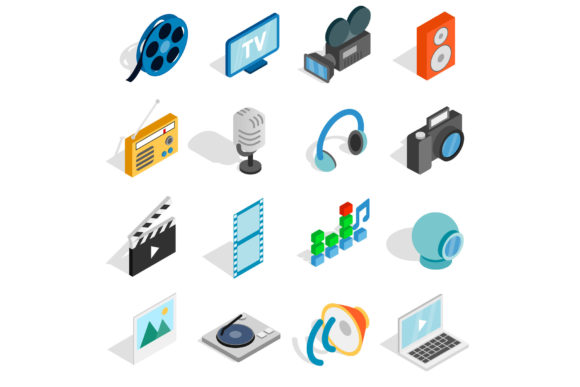
The transition from two-dimensional flat icons to isometric representations marks a maturation in how users perceive digital tools. An isometric media icons set provides a pseudo-3D perspective that allows designers to illustrate complex objects—such as cameras, microphones, speakers, and storage devices—with a tangible sense of volume and space. This approach leverages the mathematical precision of isometric projection, where parallel lines remain parallel and angles are consistent, creating a cohesive visual system that feels both modern and grounded. When implemented correctly, these icons reduce cognitive load by making abstract functions feel concrete and accessible.
The Strategic Advantage of Depth in User Interface Design
The primary value proposition of utilizing a Media Icons Set, Isometric 3d Style lies in its ability to establish a clear visual hierarchy. In an era where screens are saturated with information, distinctiveness is paramount. Flat icons, while efficient, can sometimes blend into the background, requiring users to pause and interpret symbols. Isometric icons, by contrast, pop off the screen. The illusion of depth draws the eye naturally, guiding users toward key interactive elements such as "Record," "Play," or "Upload" buttons without the need for excessive labeling.
Furthermore, the aesthetic appeal of isometric design fosters a sense of premium quality. Brands aiming to project innovation and technological sophistication often adopt this style to differentiate themselves from competitors relying on standard vector libraries. The intricate shading, lighting, and perspective inherent in an isometric media icons set suggest a higher level of craftsmanship. This psychological association can enhance user trust and engagement, as the interface itself feels more robust and thoughtfully constructed.
From a usability standpoint, the three-dimensional nature of these icons aids in state differentiation. Designers can easily manipulate the lighting or angle of an isometric object to indicate different states—active, inactive, hovered, or pressed. For instance, a media player icon might appear slightly elevated when active, casting a shadow that implies it is ready for interaction, whereas a disabled state could be rendered with muted tones and reduced contrast. This dynamic capability enriches the feedback loop between the user and the application, making the digital experience more intuitive.
Versatility Across Web and Mobile Platforms
One of the defining characteristics of a high-quality universal media icons set is its adaptability across various platforms and screen sizes. Whether designing for a expansive desktop dashboard or a compact mobile interface, isometric icons maintain their legibility and impact. The geometric consistency of the isometric grid ensures that icons scale gracefully. When rendered as vector illustrations, these assets remain crisp at any resolution, a crucial factor given the proliferation of high-DPI displays in modern smartphones and tablets.
For mobile UI, where screen real estate is at a premium, the clarity offered by 3D-style icons is particularly beneficial. Touch targets need to be immediately recognizable to prevent user error. A well-crafted isometric microphone icon, for example, leaves no ambiguity about its function, even when displayed at smaller sizes. The added dimension helps separate the icon from the background, ensuring it remains visible regardless of the color scheme or texture used in the app's theme.
In web development, these icons serve as powerful storytelling elements. Landing pages often utilize large, hero-section graphics to explain product features. An isometric media icons set can be expanded into full scenes, showing how different media elements interact within a workflow. A cloud storage service might depict a folder, a server, and a synchronization arrow in a unified isometric scene, instantly communicating the concept of data backup without a single word of copy. This visual shorthand is invaluable for reducing bounce rates and increasing conversion.
Technical Specifications and File Format Flexibility
The utility of any design asset is heavily dependent on its technical delivery. Professional-grade icon sets are typically distributed in a variety of formats to accommodate different stages of the design and development workflow. Understanding the specific strengths of formats like JPG, EPS, AI, PSD, and PNG is essential for maximizing the potential of a Media Icons Set, Isometric 3d Style.
AI (Adobe Illustrator) and EPS (Encapsulated PostScript) files are the backbone of professional vector work. These formats store mathematical paths rather than pixels, allowing designers to resize icons infinitely without any loss of quality. For creators who need to customize colors, adjust stroke weights, or modify the geometry of an icon to fit a specific brand guideline, AI and EPS are indispensable. They provide the ultimate flexibility, enabling the deconstruction of complex isometric shapes into editable layers.
For raster-based workflows, PSD (Photoshop Document) files offer layered control over textures, shadows, and lighting effects. This is particularly useful when integrating icons into photorealistic mockups or when applying complex blending modes that vectors alone cannot achieve. PSDs allow for non-destructive editing, meaning designers can experiment with different looks while preserving the original asset integrity.
When it comes to implementation in final products, PNG (Portable Network Graphics) is the industry standard for web and mobile deployment. PNGs support transparency, which is critical for placing icons over varied backgrounds without unsightly white boxes. High-resolution PNG exports ensure that the fine details of the isometric perspective remain sharp on retina displays. While JPG files are less common for icons due to their lack of transparency support and compression artifacts, they may still be utilized for preview galleries or documentation where file size is a stricter constraint than image fidelity.
Practical Applications for Diverse User Groups
The application of an isometric media icons set extends far beyond traditional software development. Educators and e-learning professionals can utilize these visuals to create engaging instructional materials. Complex media production workflows, such as video editing pipelines or audio mixing processes, can be simplified into digestible visual steps using isometric diagrams. The spatial arrangement helps learners understand the sequence and relationship between different tools and stages.
Business owners and marketers also find immense value in these assets for presentation decks and pitch materials. When explaining a new media platform or a content strategy, generic clip art often fails to convey professionalism. Isometric icons, with their polished and modern appearance, elevate the perceived value of the proposal. They help visualize abstract concepts like "streaming," "broadcasting," or "digital archiving" in a way that resonates with stakeholders and investors.
Researchers and data analysts can employ these icons to categorize and visualize datasets related to media consumption. In dashboards tracking video views, audio downloads, or image shares, isometric icons serve as effective legends and markers. Their distinct shapes make it easier for viewers to differentiate between data series at a glance, improving the overall readability of complex charts and graphs.
Even hobbyists and content creators benefit from the accessibility of these universal elements. With the rise of DIY media production, individuals are constantly seeking assets to enhance their personal brands, YouTube thumbnails, or podcast cover art. An isolated vector illustration of a high-quality camera or microphone allows creators to produce professional-looking graphics without needing advanced illustration skills. The availability of multiple formats ensures that whether they are using Canva, Photoshop, or a simple website builder, they can integrate these assets seamlessly.
Implementation Best Practices and Considerations
While the benefits of adopting a Media Icons Set, Isometric 3d Style are clear, successful implementation requires adherence to certain design principles. Consistency is the most critical factor. Isometric drawings rely on a specific angle, typically 30 degrees, to maintain the illusion of 3D space. Mixing icons with differing perspectives or light sources can break the immersion and create visual dissonance. It is vital to select a comprehensive set where all elements share the same geometric rules and lighting direction.
Color palette management is another key consideration. Isometric icons often utilize gradients and shadows to create depth. When integrating these into a UI, designers must ensure that the icon colors harmonize with the overall interface theme. Overly saturated or clashing colors can distract from the content. Often, it is effective to use a monochromatic or analogous color scheme for the icons, reserving bold accent colors for primary call-to-action elements.
Performance optimization should also be prioritized, especially for web applications. While vector formats like SVG (derived from AI or EPS) are ideal for scalability, complex isometric illustrations can sometimes result in large file sizes if they contain thousands of anchor points. Designers should streamline paths and remove unnecessary metadata before exporting. For raster formats like PNG, appropriate compression techniques should be applied to balance visual quality with loading speed, ensuring a smooth user experience across all connection types.
The Future of Isometric Visual Language
As technology continues to advance, the role of isometric design is likely to expand. With the growing interest in augmented reality (AR) and virtual reality (VR), the visual vocabulary established by isometric media icons set collections serves as a foundational step toward fully immersive 3D interfaces. The familiarity users have developed with these pseudo-3D representations prepares them for more spatial computing experiences.
Moreover, the demand for customization drives the evolution of these asset libraries. Modern sets are increasingly modular, allowing designers to mix and match components to create unique scenarios. This modularity empowers creators to tell specific stories relevant to their niche, moving away from the one-size-fits-all approach of the past. The availability of source files in AI, PSD, and EPS formats ensures that these icons are not static images but living design systems that can grow and adapt with the project.
In conclusion, the integration of a Media Icons Set, Isometric 3d Style represents a strategic investment in the quality and effectiveness of digital communication. By combining aesthetic sophistication with functional clarity, these universal media elements empower professionals, creators, and businesses to build interfaces that are not only beautiful but deeply intuitive. As the digital world becomes increasingly crowded, the ability to stand out through thoughtful, dimensional design will remain a key differentiator for success.