Why a Flat Style Boat and Ship Icons Set is Essential for Modern Digital Design
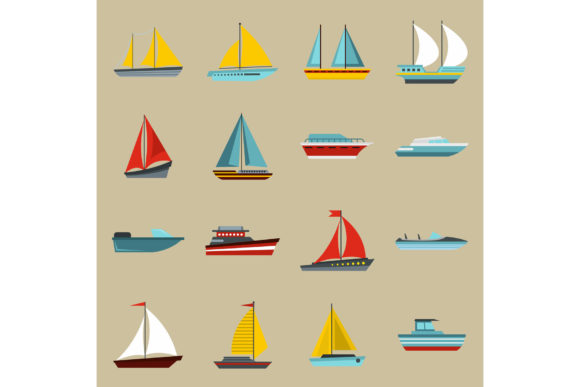
In the fast-paced world of digital design, clarity often beats complexity. When you are building a website for a logistics company, designing a travel app for island hopping, or creating an educational module about maritime history, the last thing your users need is visual clutter. This is where a Boat and Ship Icons Set, Flat Style becomes an invaluable asset. Unlike detailed illustrations that can look muddy on small screens or distract from core content, flat icons offer clean lines, bold colors, and immediate recognizability. They strip away unnecessary shadows and gradients to focus purely on the shape and function of the vessel, making them perfect for modern user interfaces.
The versatility of these assets cannot be overstated. Whether you are a freelance web developer working on a tight deadline or a marketing manager launching a new campaign for a cruise line, having access to a universal set of ship elements allows you to communicate complex ideas instantly. A simple icon of a cargo ship tells a story of global trade faster than a paragraph of text ever could. Similarly, a sleek yacht icon immediately evokes feelings of luxury and leisure. By utilizing a cohesive flat ship icons set, you ensure that your visual language remains consistent across different pages and devices, which is crucial for building trust with your audience.
Real-World Applications Across Industries
The utility of these icons extends far beyond simple decoration. In the realm of e-commerce and logistics, for instance, clarity is king. Imagine you are managing the dashboard for a supply chain management tool. Your users need to track shipments in real-time. Using distinct icons for container ships, tankers, and ferries helps operators distinguish between different types of cargo at a glance. When these icons are rendered in a flat style, they load quickly and remain crisp even when scaled down to fit into a dense data table. This isn't just about aesthetics; it's about functional efficiency that prevents costly misunderstandings in high-stakes environments.
Tourism and travel agencies also benefit immensely from these resources. If you are a blogger writing about the best ferry routes in Greece or a startup launching an app for booking boat tours, your interface needs to feel inviting and easy to navigate. A well-designed set of basic ship elements can guide users through a booking process without overwhelming them. You might use a sailboat icon to represent leisure activities, a speedboat for water sports, and a large cruise liner for accommodation options. Because these are vector illustrations, you can recolor them to match your brand's palette perfectly, ensuring that your site feels custom-built rather than templated.
Educators and publishers find unique value in these sets as well. When creating interactive learning materials for children or informational graphics for a museum exhibit, simplicity aids comprehension. A flat icon of a submarine or a tugboat is easily recognizable by learners of all ages. It removes the cognitive load of interpreting complex artistic styles, allowing the student to focus on the subject matter. For textbook publishers moving toward digital formats, having scalable assets in formats like EPS or AI means the graphics will look sharp on everything from a smartphone screen to a large interactive whiteboard.
Technical Advantages for Developers and Designers
From a technical standpoint, the format availability of these icon sets is a game-changer. Professional designers know that flexibility is key. Having access to files in JPG, EPS, AI, PSD, and PNG ensures that no matter what stage of the workflow you are in, you have the right tool for the job. If you are a UI designer working in Figma or Sketch, you can import the SVG or AI files to tweak anchor points and adjust strokes directly within your design software. This level of control is essential when you need to align an icon perfectly with a specific grid system or modify a hull shape to better fit a unique brand identity.
For developers who might not have advanced design skills, the PNG versions with transparent backgrounds are a lifesaver. They can be dropped straight into code without needing to mess around with Photoshop layers. The flat style inherently lends itself to smaller file sizes compared to photorealistic images, which contributes to faster page load times—a critical factor for SEO and user retention. Google prioritizes sites that load quickly, so using optimized vector-based icons instead of heavy photographs can indirectly boost your search rankings while improving the user experience.
Furthermore, the isolation of elements in these sets allows for creative modularity. You aren't stuck with a static image. You can take the hull from one icon and the mast from another to create a custom vessel that fits a very specific niche scenario. This modularity encourages experimentation. A game developer creating a 2D mobile game about ocean exploration could use these base elements to construct hundreds of unique ships without needing to draw every single pixel from scratch. It accelerates the prototyping phase and allows teams to test different visual directions rapidly.
Choosing the Right Assets for Your Project
Before you download or purchase a Boat and Ship Icons Set, Flat Style, there are a few practical considerations to keep in mind. First, evaluate the consistency of the stroke width and corner radius across the set. In flat design, even minor inconsistencies can make an interface feel unpolished. Look for a set where the visual weight of a tiny dinghy matches that of a massive oil tanker; this balance ensures that no single element accidentally dominates the layout due to poor proportioning.
Second, consider the scalability of the details. While flat design is minimal, some icons include tiny portholes or rigging lines. Ask yourself if these details will vanish when the icon is displayed on a mobile notification bar. The best sets are designed with legibility in mind, ensuring that the core silhouette remains identifiable even at 16x16 pixels. If an icon relies too heavily on fine lines to convey its meaning, it might fail in responsive environments where screen real estate is limited.
It is also wise to think about color psychology. While many flat sets come in monochrome or standard primary colors, the ability to customize them via AI or PSD files is crucial. A shipping company might want deep navy blues and greys to convey reliability, while a summer camp might prefer bright yellows and teals to evoke fun. Ensure the file formats you choose support easy color manipulation. Vector formats like EPS and AI are superior here, as they allow for global color changes without degrading image quality, whereas raster formats like JPG can become pixelated or lose definition when edited repeatedly.
- Versatility: Ensure the set covers a wide range of vessels, from personal kayaks to industrial freighters, to future-proof your content.
- Format Flexibility: Prioritize sets offering both vector (AI, EPS) and raster (PNG, JPG) options to cover all bases from print to web.
- License Clarity: Always check if the license allows for commercial use, especially if you are integrating these icons into a product you plan to sell or a client's website.
- Scalability: Test the icons at various sizes to confirm that the flat style remains clear and distinct on high-resolution retina displays.
Ultimately, integrating a high-quality flat ship icons set into your workflow is about more than just filling space on a screen. It is about enhancing communication, streamlining development, and creating a polished professional image. Whether you are mapping out a global supply chain, planning a vacation itinerary, or teaching the next generation about marine biology, the right visual tools make the difference between confusion and clarity. By choosing assets that are technically robust and visually adaptable, you empower yourself to create digital experiences that are not only functional but also engaging and memorable.