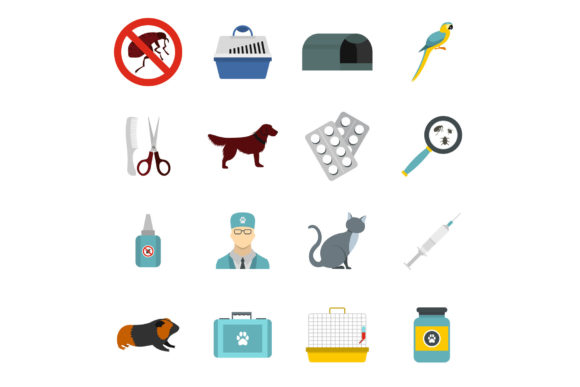
Enhancing Digital Veterinary Experiences with Flat Style Iconography
In the rapidly evolving landscape of digital healthcare, the visual language used to communicate complex medical concepts plays a pivotal role in user engagement and comprehension. For the veterinary sector, where trust and clarity are paramount, the choice of graphical assets can significantly influence how pet owners, professionals, and administrators interact with software and websites. A Veterinary Icons Set, Flat Style offers a modern, streamlined approach to visual communication that aligns perfectly with contemporary design trends while addressing the specific needs of animal care interfaces.
The shift toward flat design in user interface (UI) development is not merely an aesthetic preference; it is a functional evolution. By stripping away unnecessary textures, gradients, and three-dimensional effects, flat icons focus on the essence of the symbol. When applied to veterinary elements—isolated vector illustrations of stethoscopes, paw prints, syringes, and anatomical diagrams—this style ensures that information is conveyed instantly, regardless of the device or screen size. This article explores the multifaceted utility of these universal veterinary icons, examining their technical advantages, practical applications across various platforms, and their impact on the broader ecosystem of animal health technology.
The Functional Advantages of Vector-Based Flat Design
At the core of any high-quality Flat veterinary icons set lies the versatility of vector formats such as EPS, AI, and SVG. Unlike raster images (JPG, PNG) which are composed of a fixed grid of pixels, vector graphics are defined by mathematical equations. This distinction is critical for veterinary applications that must function seamlessly across a fragmented device landscape, ranging from large desktop monitors in clinic administration rooms to small smartphone screens used by pet owners tracking vaccination schedules.
When designers utilize files in AI or EPS formats, they gain the ability to scale icons infinitely without any loss of resolution. A paw print icon used on a business card can be enlarged for a billboard or a clinic wall display without becoming pixelated or blurry. Furthermore, the flat style inherently reduces visual noise. In a medical context, where users may be stressed or seeking urgent information, cognitive load must be minimized. Flat icons provide immediate recognition, allowing users to navigate menus and understand status indicators—such as "urgent care" or "routine checkup"—without deciphering complex artistic details.
The availability of layered source files, particularly in PSD and AI formats, empowers creators to customize these universal elements. A web developer might need to adjust the color palette of a stethoscope icon to match a specific brand identity, while an educator creating materials for veterinary students might need to isolate specific components of an anatomical diagram. The modular nature of these sets facilitates such modifications, ensuring that the visual assets remain consistent with the overall branding strategy of the organization.
Diverse Applications in Web and Mobile Interfaces
The utility of a comprehensive Veterinary Icons Set, Flat Style extends far beyond simple decoration. These assets serve as functional navigational aids and informational markers in a wide array of digital products. For mobile application developers creating tools for pet management, these icons are indispensable. Consider an app designed to track a dog's medication schedule. Using a clear, flat icon of a pill bottle or a syringe provides an intuitive visual cue that transcends language barriers, making the app accessible to a global audience.
In the realm of telemedicine, which has seen explosive growth in the veterinary field, user interface clarity is essential. Veterinarians conducting remote consultations rely on software that allows them to quickly access patient records, upload imaging, and prescribe treatments. A well-organized toolbar featuring flat icons for "file upload," "video call," "prescription pad," and "patient history" streamlines the workflow, reducing the time spent navigating menus and increasing the time available for patient care. The isolation of these vector illustrations ensures they stand out clearly against various background colors, maintaining legibility in both light and dark modes.
Educational platforms also benefit significantly from these resources. Researchers and educators developing e-learning modules for veterinary technicians require visuals that accurately represent tools and procedures without being overly graphic or distracting. A set of basic veterinary elements, rendered in a clean flat style, can illustrate steps in a surgical procedure, identify different breeds, or explain nutritional requirements. Because these icons are universally understood, they enhance the learning experience for students at all levels, from hobbyists interested in animal care to professionals pursuing advanced certifications.
Optimizing for Business and Consumer Engagement
For business owners operating veterinary clinics, grooming salons, or pet supply stores, the website often serves as the first point of contact with potential clients. The visual professionalism of the site directly correlates with the perceived quality of care. Incorporating a cohesive Flat veterinary icons set helps establish a modern, trustworthy brand image. Services such as boarding, grooming, dental care, and emergency surgery can be represented by distinct, easily recognizable icons on the homepage, allowing visitors to find relevant information quickly.
Moreover, these icons play a crucial role in improving Search Engine Optimization (SEO) and accessibility when implemented correctly. While search engines cannot "see" images, the alt text associated with these icons provides context. When a developer uses descriptive alt tags like "flat vector icon of a cat vaccination," it contributes to the semantic relevance of the page. Additionally, because flat icons typically have smaller file sizes compared to complex 3D renders or high-resolution photographs, they contribute to faster page load times—a critical ranking factor for Google and a key determinant of user retention.
Consumer-facing apps also leverage these icons to gamify health tracking and encourage engagement. Features like "daily walk tracker" or "weight loss journey" become more inviting when accompanied by friendly, approachable flat graphics. The psychological impact of soft shapes and harmonious colors found in flat design can reduce anxiety associated with medical topics, making the digital experience more comforting for pet owners worried about their animal's health.
Technical Considerations and Format Selection
Selecting the appropriate file format from a veterinary icon pack is a decision that impacts workflow efficiency and final output quality. Understanding the strengths of each format—JPG, EPS, AI, PSD, PNG—is essential for maximizing the value of the asset library.
- PNG: Ideal for immediate use in web development and mobile UI where transparency is required. PNGs support alpha channels, allowing the flat icons to sit cleanly over colored backgrounds without a white box surrounding them. They are widely supported across all browsers and operating systems.
- JPG: Best suited for photographic contexts or situations where file size is the absolute priority and transparency is not needed. However, for sharp, crisp icons, JPG compression artifacts can sometimes degrade quality, making it less ideal for line art.
- EPS and AI: These are the industry standards for print and scalable vector graphics. They are essential for designers who need to edit the paths, change colors, or resize the Veterinary Icons Set, Flat Style for large-format printing such as banners, brochures, or signage within a clinic.
- PSD: Photoshop documents offer layer-based editing, which is useful for compositing icons into complex marketing materials or adding specific lighting effects and shadows if the design direction shifts away from pure flatness.
When integrating these assets into a project, consistency is key. Mixing different styles—for example, combining flat icons with skeuomorphic or hand-drawn illustrations—can create a disjointed user experience. Sticking to a single, unified set of universal veterinary elements ensures visual harmony. Developers should also consider the stroke weight and level of detail in the icons. On very small screens, overly intricate details may vanish; therefore, selecting a set designed with mobile responsiveness in mind is advisable.
Bridging the Gap Between Professionals and Pet Owners
The ultimate goal of utilizing high-quality visual assets in veterinary technology is to bridge the communication gap between medical professionals and pet owners. Complex medical data, treatment plans, and preventative care schedules can be intimidating. A well-designed interface using a Flat veterinary icons set demystifies this information. It transforms abstract data into tangible, understandable concepts.
For instance, a discharge summary provided digitally to a pet owner can use icons to highlight key instructions: a bowl for feeding guidelines, a clock for medication timing, and a thermometer for monitoring temperature. This visual reinforcement improves compliance and outcomes. Similarly, in research settings, data visualization tools can employ these icons to categorize studies by species or treatment type, making large datasets more approachable for reviewers and stakeholders.
As the veterinary industry continues to digitize, the demand for specialized, high-quality graphic resources will only grow. The adoption of flat style iconography represents a commitment to clarity, efficiency, and user-centric design. Whether for a startup developing the next great pet health app, an established clinic revamping its online presence, or an educator creating the next generation of learning materials, the strategic use of these isolated vector illustrations provides a solid foundation for success. By prioritizing functionality and aesthetic coherence, creators can build digital environments that not only look professional but also genuinely serve the needs of the animals and the people who care for them.